
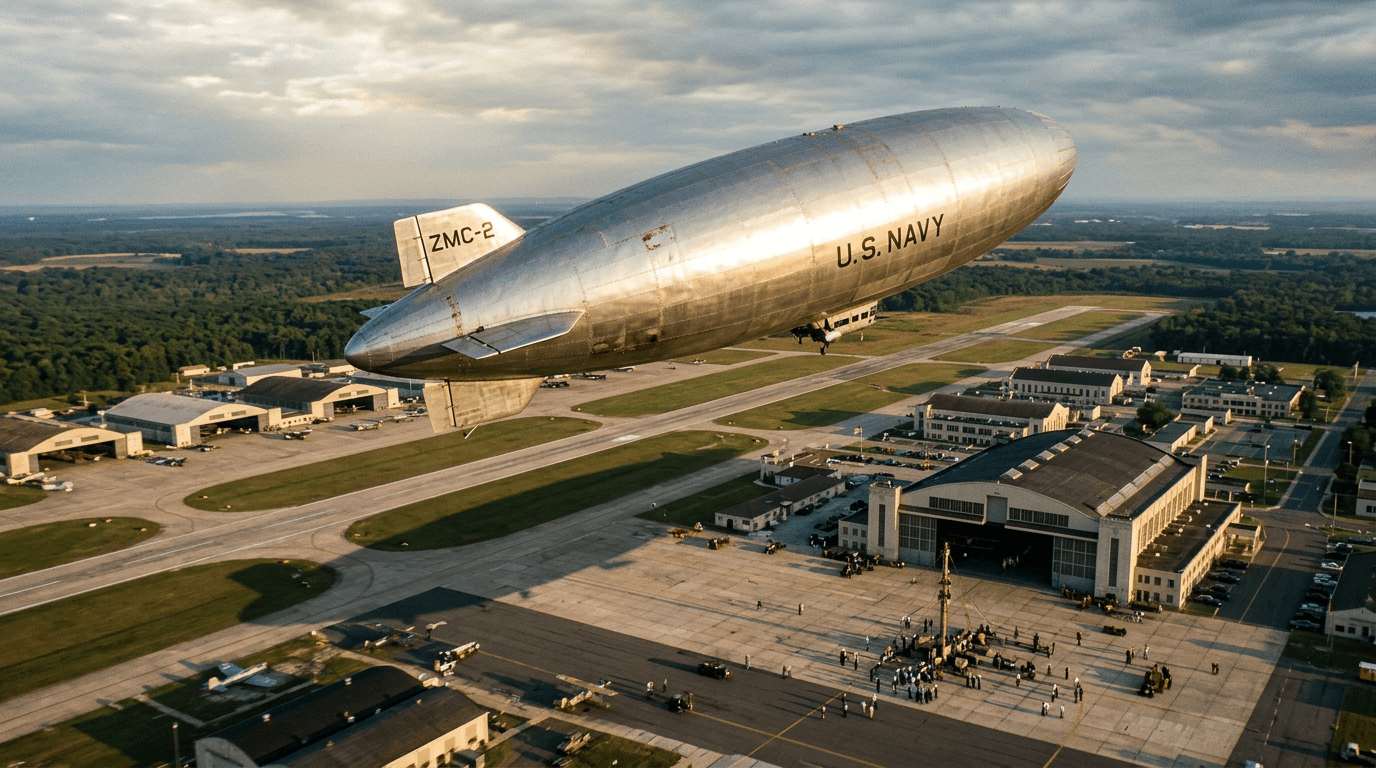
The Detroit ZMC-2, often nicknamed the “Tin Blimp,” was a groundbreaking rigid airship notable for being the only successfully operated metal-skinned lighter-than-air craft in history. It defied its popular moniker, being neither made of tin nor a blimp in the traditional sense, as its revolutionary metal skin provided structural rigidity, a stark contrast to fabric blimps that maintain shape through internal gas pressure. This engineering marvel, designed by renowned balloonist Ralph Hazlett Upson, represented a bold leap in aviation technology, aiming to overcome the inherent vulnerabilities of its fabric-covered predecessors.
The Genesis of a Metalclad Marvel
The journey of the ZMC-2 began in 1922 with its design and development, culminating in a U.S. Navy contract awarded in August 1926. Construction commenced swiftly on March 7, 1927, at Naval Air Station Grosse Ile near Detroit, Michigan. The Aircraft Development Corporation, later known as Metalclad Airship Corporation, undertook this ambitious project. At its core, the ZMC-2 featured an all-aluminum envelope that directly contained helium, eliminating the need for internal gas cells. This hull was crafted from Alclad, a corrosion-resistant aluminum alloy – specifically, duralumin sheets coated with pure aluminum, measuring approximately 0.0095 inches thick. The true marvel of its construction lay in the estimated 3,500,000 tiny rivets, meticulously joining these sheets, with seams sealed using a bituminous material to ensure gas-tightness. Edward J. Hill’s invention of a specialized riveting machine was absolutely crucial to this unprecedented assembly process.
“The ZMC-2 was a testament to American ingenuity, pushing the boundaries of what was thought possible in lighter-than-air flight with its unique metal-skinned construction.”
A Decade of Innovation: The Detroit ZMC-2 in Service
The ZMC-2’s maiden flight on August 19, 1929, from Grosse Ile, lasting 49 minutes and reaching 1,000 feet, marked a triumphant moment. Soon after, on September 11-12, 1929, it was delivered to Naval Air Station Lakehurst, New Jersey, its primary base of operations, and formally accepted by the U.S. Navy. For a decade, under the command of Lieutenant (j.g.) Hammond J. Dugan, who initially harbored skepticism about its safety, the ZMC-2 proved its worth. It completed an impressive 752 flights, logging 2,265 hours, demonstrating remarkable durability and excellent helium retention. Its operational capabilities, though limited by its small size, showcased the potential of metal-clad designs for naval applications like anti-submarine patrols. With a length of 149.5 feet, a diameter of 52.7 feet, and powered by two 220-horsepower Wright J-5 radial engines, it achieved a top speed of 62 mph and a range of 680 miles.
Despite its technical successes and the crucial insights it provided into advanced airship design, the ZMC-2 project faced significant headwinds. The financial collapse of its builder during the Great Depression and a strategic shift in Navy interest towards larger, albeit more conventional, fabric-covered airships ultimately prevented further development of the metal-clad concept. Its last flight took place on August 19, 1939, and it was decommissioned and scrapped in 1941, marking the end of an era for this unique aircraft.
The Enduring Legacy of the Metalclad Airship
While the Detroit ZMC-2 did not lead to a fleet of metal-skinned airships, its story remains a fascinating chapter in aviation history. It successfully validated the concept of a rigid, metal-skinned lighter-than-air craft, demonstrating superior durability and helium retention compared to its fabric counterparts. Its pioneering construction methods, particularly the extensive use of millions of tiny rivets and specialized machinery, offered invaluable lessons in large-scale metal fabrication. The ZMC-2 stands as a testament to the ambitious spirit of early 20th-century engineering, a bold experiment that, despite its premature end, left an indelible mark on the pursuit of innovative flight technologies. It remains the only successfully operated metal-skinned lighter-than-air craft, a singular achievement in the annals of related Industries news.


