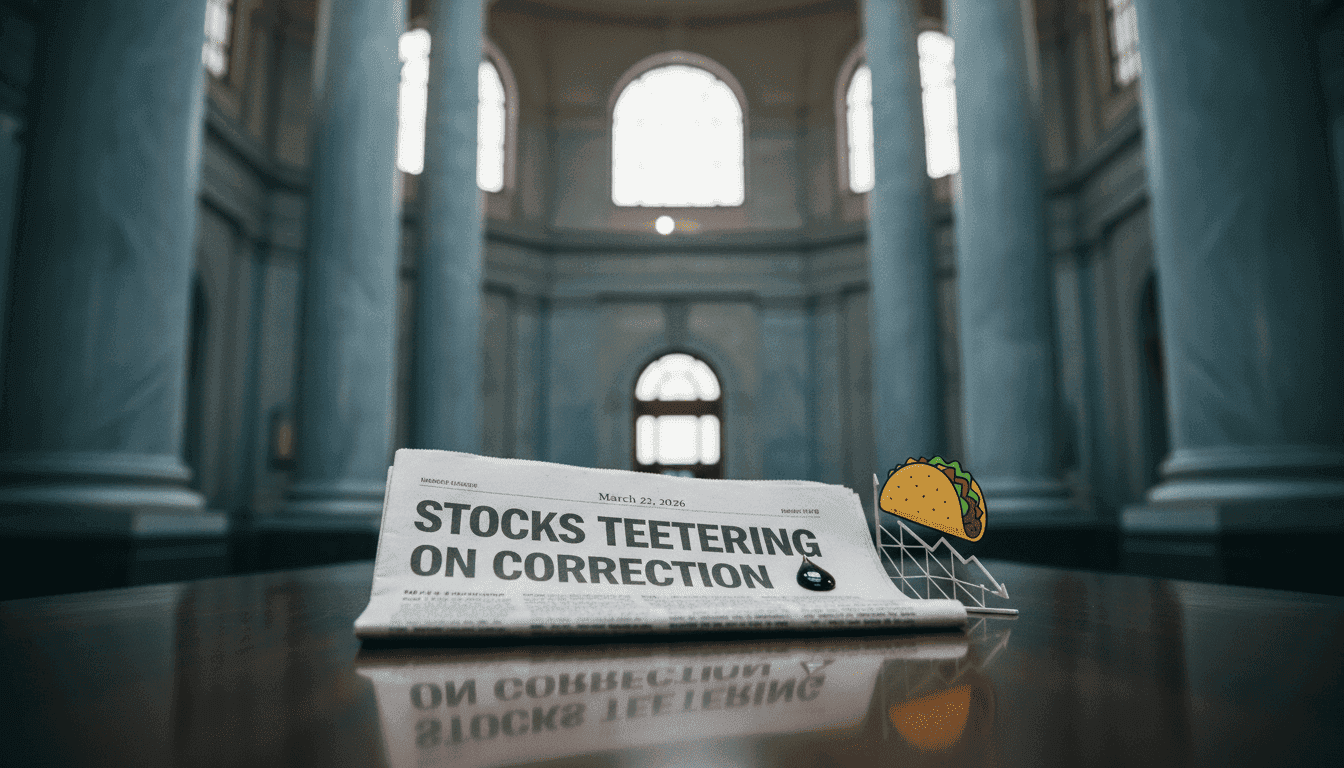
A critical market correction looms as major indices teeter on the brink, raising questions about the reliability of the ‘TACO trade’ amidst the escalating Iran conflict. A MarketWatch headline from March 22, 2026, starkly reported that “Stocks are teetering on the edge of correction territory,” directly challenging the optimistic market rebound strategy.
Understanding Correction Territory
In the intricate world of stock markets, “correction territory” signifies a decline of at least 10% but less than 20% from a recent peak. This threshold can apply to an overall market, a specific index, a sector, or even an individual security. Such dips are generally considered a natural and often transient phase within the broader market cycle, typically seeing recovery within a few weeks to a few months. However, a more severe drop of 20% or more is universally recognized as the onset of a bear market. As of March 22, 2026, the S&P 500 had experienced a 6.8% downturn from its January peak, while the Dow Jones Industrial Average was down 9.2%, and the Nasdaq Composite had slumped 9.6% from their respective all-time closing highs. These figures placed both the Nasdaq and Dow precariously close to entering correction territory.
The ‘TACO Trade’ Explained
The intriguing term “TACO trade,” an acronym for “Trump Always Chickens Out,” was coined by Financial Times columnist Robert Armstrong. It encapsulates a discernible pattern observed during Donald Trump’s presidency: initial aggressive tariff threats would trigger an immediate dip in the stock market, only for Trump to subsequently soften, delay, or entirely abandon these threats, invariably leading to a market rebound. This predictable sequence evolved into a recognized trading strategy, where investors would buy the dip in anticipation of Trump’s eventual reversal, profiting from the subsequent rally.
Why the ‘TACO trade’ Could Flop
The escalating Iran conflict presents a formidable challenge to the efficacy of the ‘TACO trade’. Unlike the tariff policies, which were largely within Trump’s executive power to reverse, the current geopolitical landscape involves kinetic conflict and tangible supply chain disruptions, most notably impacting global oil prices. Surging oil prices pose a significant threat to global inflation and economic stability, making a swift and straightforward market rebound far less probable.
“The longer and deeper the conflict, the harder it will be to resolve, potentially leading to longer-lasting damage to the markets,” warned Chris Maxey, chief market strategist at Wealthspire.
Adding to this skepticism, JPMorgan’s former quant chief, Marko Kolanovic, has bluntly stated that “Trump can fix very little” in this complex scenario, questioning whether Trump still possesses the “off switch” for the escalating conflict and its profound impact on oil markets. The White House’s conflicting messages—simultaneously suggesting a “winding down” of the conflict while deploying additional military assets to the Middle East—further complicate the outlook. Coupled with Iran’s strategic actions, such as the blockade of the Strait of Hormuz and targeted strikes on energy infrastructure, these developments severely undermine any hopes for a rapid market recovery and could cause a critical market correction.
The confluence of these factors suggests that the once-reliable ‘TACO trade’ may no longer be a viable strategy. Investors are grappling with a geopolitical crisis that transcends typical policy reversals, demanding a reassessment of market expectations and a preparedness for sustained volatility as major indices face a potential critical market correction.