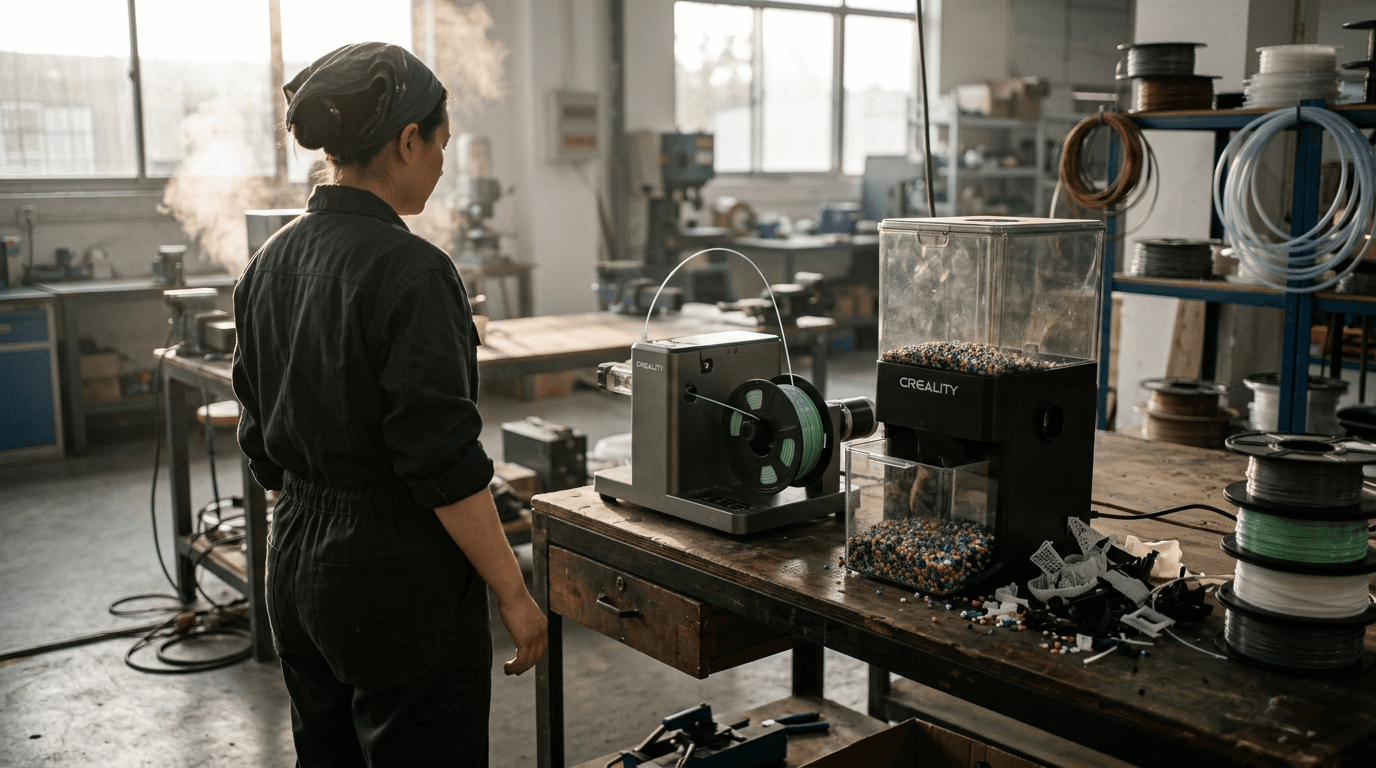
The Creality M1 Filament Maker, alongside its companion R1 Filament Shredder, is set to revolutionize 3D printing recycling by offering a desktop solution for makers to transform plastic waste into new filament. Officially launched via an Indiegogo crowdfunding campaign in March 2026, this innovative system from Creality addresses the significant issue of plastic waste generated by failed prints and scraps, aiming to create a “closed-loop filament workflow” for the burgeoning 3D printing community.
Understanding the Creality M1 Filament Maker System
At its core, the Creality recycling system comprises two distinct yet complementary machines. The R1 Filament Shredder is engineered to break down waste filament and failed 3D prints into small, uniform particles, typically ≤4mm. Utilizing a hybrid “dry-crush” approach, it also integrates a crucial drying function, preparing the material for the next stage. Following this, the M1 Filament Maker takes these shredded pellets, melts them down, and precisely extrudes them into new 3D printer filament. This unit boasts multi-zone temperature control and an integrated take-up spooling system, ensuring the freshly made filament is wound accurately.
Key Features and Performance Metrics
The M1 Filament Maker offers impressive capabilities for its class. It can produce up to 1 kg of new filament per hour, making it suitable for active makers. The system demonstrates broad material compatibility, supporting eight major filament families including PLA, ABS, PETG, ASA, PA, PC, TPU, and PET. While using virgin pellets, the M1 achieves a diameter tolerance of ±0.05mm. However, when processing recycled pellets from the R1, this tolerance widens to ±0.1mm. This distinction is important, as commercial filaments typically maintain a tighter tolerance of ±0.02-0.03mm. Furthermore, the M1 allows for extensive customization, enabling users to mix virgin pellets with color masterbatch, glitter, natural powders like coffee or wood shavings, or even fibers to craft unique and bespoke filaments.
Market Impact and Return on Investment
The primary driver behind the M1 and R1 system is the pressing need to mitigate the substantial plastic waste generated by 3D printing. Failed prints, support structures, and purge blocks from multi-color systems like Bambu Lab’s AMS often end up in landfills due to a lack of specific recycling stamps accepted by municipal facilities. While the system presents a compelling solution for waste reduction and potential cost savings through the use of cheaper virgin pellets, the return on investment (ROI) for individual users is highly dependent on their printing volume.
“For users with high printing volumes, particularly those generating significant ‘filament poo’ from multi-color systems, the Creality M1 and R1 bundle could offer a justifiable investment for creating draft prints and prototypes where the ±0.1mm tolerance of recycled filament is acceptable.”
However, for single-printer users generating less than 1-2kg of waste per month, the payback period based solely on filament savings could extend to several years. It’s also critical to note that repeated heating and extrusion cycles can lead to molecular degradation, potentially resulting in weaker recycled filament. Shipping for the system is expected to commence in Q2 2026, with free shipping offered to the contiguous US, UK, and all EU countries, inclusive of VAT and customs fees, making the initial investment more transparent for international backers.
Pricing Tiers and Accessibility
The Creality M1 and R1 system was introduced with varied pricing structures to incentivize early adoption. VIP pricing for deposit holders stood at $649 for the M1, $349 for the R1, and a bundle price of $899. Super Early Bird backers on Indiegogo could secure the M1 for $799, the R1 for $499, or the bundle for $1,199. The anticipated MSRP for the M1 is $1,149, the R1 at $649, and the full bundle at $1,699. A refundable $50 deposit allowed users to lock in the advantageous VIP pricing.
The Creality M1 Filament Maker and R1 Shredder represent a significant stride towards sustainable 3D printing, offering a tangible solution to the industry’s plastic waste problem. While the economic viability for individual users will vary, the system’s potential to foster a circular economy within the maker community and reduce environmental impact is undeniable. This innovative offering could redefine how enthusiasts and small businesses approach filament consumption and waste management, pushing the boundaries of what’s possible in related Industries news.