
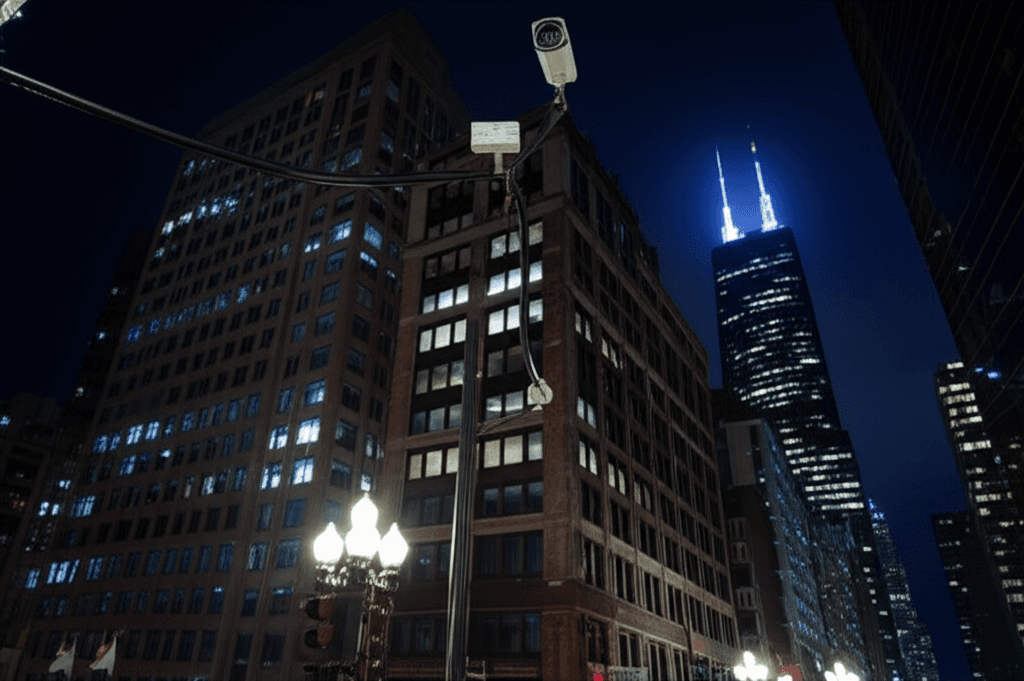
Chicago surveillance network is facing both expansion and intense scrutiny. Early on the morning of September 2, 2024, a Chicago Transit Authority Blue Line train was the scene of a random and horrific mass shooting, highlighting the potential reach and power of the city’s vast surveillance capabilities.
The police swiftly activated a digital dragnet, connecting thousands of cameras in the city to track the alleged gunman. This swift action, while praised by some, has reignited the debate over privacy, civil liberties, and the effectiveness of such extensive monitoring.
Chicago boasts one of the largest license plate reader systems in the country, and the ability to access audio and video surveillance from independent agencies such as the Chicago Public Schools, the Chicago Park District, and the public transportation system as well as many residential and commercial security systems such as Ring doorbell cameras. Estimates suggest there are up to 45,000 surveillance cameras in the city.
The Debate Over Public Safety vs. Privacy
Law enforcement and security advocates argue that this vast monitoring system protects public safety and works well. However, activists and many residents say it’s a surveillance panopticon that creates a chilling effect on behavior and violates guarantees of privacy and free speech. The debate centers on whether the benefits of increased security outweigh the potential for abuse and the erosion of individual freedoms.
Lance Williams, a scholar of urban violence at Northeastern Illinois University, points out that Black and Latino communities in Chicago have historically been targeted by excessive policing and surveillance. He suggests that this scrutiny has created new problems without delivering the promised safety.
“To solve the problem of crime or violence and make these communities safer, you have to deal with structural problems,” such as the shortage of livable-wage jobs, affordable housing, and mental-health services across the city.
Chicago Surveillance Network: Pushback and Countervailing Forces
Recent years have seen some effective pushback against surveillance. The city was previously the largest customer of ShotSpotter acoustic sensors, designed to detect gunfire and alert police. However, after criticism regarding its effectiveness and disproportionate installation in Black and Latino neighborhoods, the city ended its contract with SoundThinking. The #StopShotSpotter movement gained momentum after the fatal shooting of 13-year-old Adam Toledo by police responding to a ShotSpotter alert.
Despite this victory, countervailing forces are at play. Governments and officials in Chicago and surrounding suburbs are moving to expand the use of surveillance, driven by public pressure for increased security. The city even issued a request for proposals for gun violence detection technology early last year. The debate surrounding the Chicago surveillance network continues to evolve.
Lucy Parsons Labs: Fighting for Digital Rights
Groups like Lucy Parsons Labs (LPL) are at the forefront of challenging surveillance practices. Based in Chicago, LPL investigates technologies such as license plate readers, gunshot detection systems, and police bodycams. They provide digital security and public records training to community groups, helping them audit and analyze surveillance systems targeting their neighborhoods.
One of LPL’s primary strategies is filing extensive FOIA requests for raw data sets of police surveillance. In Oak Park, LPL’s work revealed that the town’s license plate readers scanned 3,000,000 plates in the first 10 months, with only 42 scans leading to an alert. Furthermore, Black drivers made up 85% of those flagged by the cameras, highlighting racial disparities.
This work inspired other community-based groups across the country to challenge surveillance practices in their own areas. You can follow related Industries news to see how this landscape evolves.
“We became almost de facto experts in navigating the process and the law. I think that sort of speaks to some of the DIY punk aesthetic.”
Oak Brook’s Use of Drones
While some areas are pushing back against surveillance, others are embracing it. The Oak Brook Police Department, for example, uses drones equipped with license plate readers to combat retail theft. In one instance, a drone identified a suspect vehicle and provided high-definition photos to officers on the ground, leading to an arrest.
The use of drones represents a further expansion of surveillance capabilities, raising additional questions about privacy and the potential for misuse. The ongoing debate surrounding the Chicago surveillance network underscores the complex challenges of balancing security and civil liberties in the digital age.
Source: MIT Technology Review


