
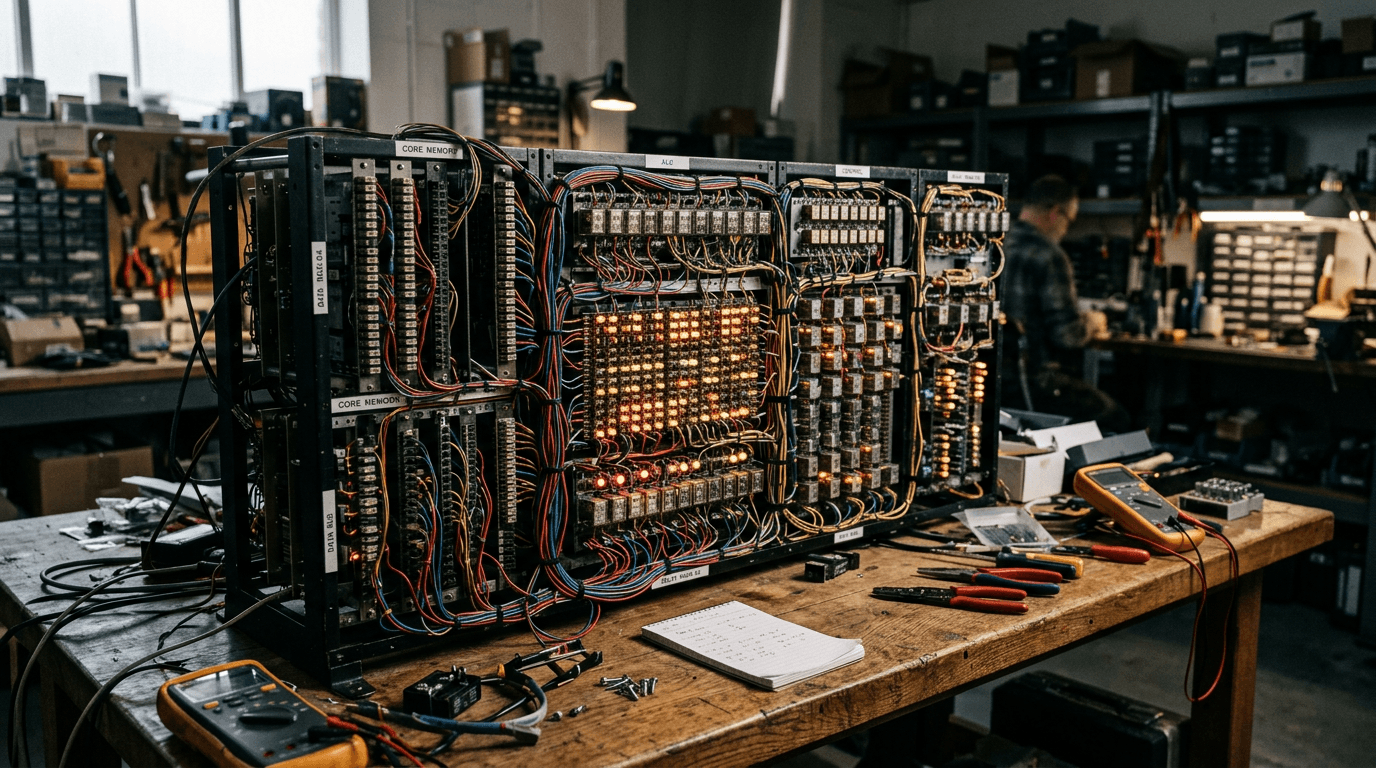
Capacitor memory technology is currently spearheading a fascinating movement within the niche hardware industry, as engineers look backward to move forward. In a recent development that has captured the attention of the historical computing community, a designer known as DiPDoT has successfully transitioned a homebrew relay computer from modern SRAM to a historically plausible memory system. This shift represents more than just a hobbyist’s whim; it is a sophisticated engineering feat that mirrors the constraints and breakthroughs of the 1940s, providing a tangible look at the foundations of modern data processing architecture.
The Evolution of Capacitor Memory Technology
To understand the significance of this project, one must look at the landscape of 1940s computing. During that era, memory was the primary bottleneck for industrial-scale calculation. While various solutions existed, they were often fraught with logistical nightmares. Williams Tubes required rare cathode-ray tubes, mercury delay lines presented significant toxicity risks, and core rope memory demanded an almost impossible level of manual precision. By opting for capacitor memory technology, the designer has revived a method that uses electrical charge to store binary states: a charged capacitor represents a ‘1,’ while a discharged state represents a ‘0.’
This method, while conceptually simple, introduces significant industrial design challenges. Unlike modern semiconductors, capacitor-based storage is inherently destructive upon reading. When a bit is read, the capacitor must be discharged, meaning the data is erased in the process of being accessed. Furthermore, the architecture faces the ‘overwrite’ problem, where a separate ‘clear’ circuit is required to reset a bit from 1 to 0. The successful integration of an auto-clearing circuit on a breadboard demonstrates a high level of technical proficiency, ensuring that the existing relay computer architecture can function without a total overhaul of its logic gates.
Modern Components in a Historical Framework
While the goal is historical plausibility, the project does utilize some modern concessions that highlight the intersection of related Industries news and vintage aesthetics. For instance, the use of modern diodes for addressing and LEDs for status indication serves to stabilize the power draw. In the 1940s, these roles would have been filled by vacuum tube diodes or point-contact diodes, which are significantly more power-hungry and prone to failure. By substituting these with modern equivalents, the designer ensures the relay computer remains a functional educational tool rather than a museum piece that requires constant maintenance.
“The transition from modern silicon to electromechanical storage proves that the logic of the 1940s remains a robust foundation for understanding how data moves through a system.”
The scaling of this system is equally impressive. Starting with a 4-bit word on a breadboard, the project eventually reached an 8-byte capacity hooked into a backplane reminiscent of the Altair computers. While 8 bytes may seem negligible in an era of gigabytes and terabytes, in the context of a relay-based system, it is a massive achievement. Each byte represents a physical manifestation of logic, where the ‘clack’ of the relays provides a rhythmic, auditory confirmation of the machine’s operations—a stark contrast to the silent, invisible processing of modern microchips.
Market Context and the Resurgence of Tactile Engineering
This development arrives at a time when the hardware industry is grappling with the tail end of the “rampocalypse” and fluctuating semiconductor prices. While a relay computer using capacitor memory technology will not solve the global demand for high-end GPUs, it highlights a growing market for tactile, transparent engineering. There is an increasing demand for systems where the user can physically see and hear the logic being executed. This transparency is vital for educational institutions and high-end hobbyists who feel alienated by the “black box” nature of modern integrated circuits.
The program input via the front panel, a process that takes several minutes for just a few lines of code, serves as a meditative reminder of the labor-intensive nature of early computing. It forces the operator to engage with the hardware at a granular level, a skill that is becoming increasingly rare in an automated world. The success of this project suggests that there is a viable future for “slow computing,” where the value lies not in processing speed, but in the clarity of the mechanical process and the historical accuracy of the build.
Ultimately, the integration of capacitor memory technology into a relay computer serves as a bridge between two eras. It validates the ingenuity of mid-century engineers while utilizing the accessibility of modern components to make those old ideas functional today. As we continue to push the boundaries of quantum computing and AI, these retro-innovations serve as a critical anchor, reminding the industry of the fundamental principles of charge, logic, and memory that started it all.


