
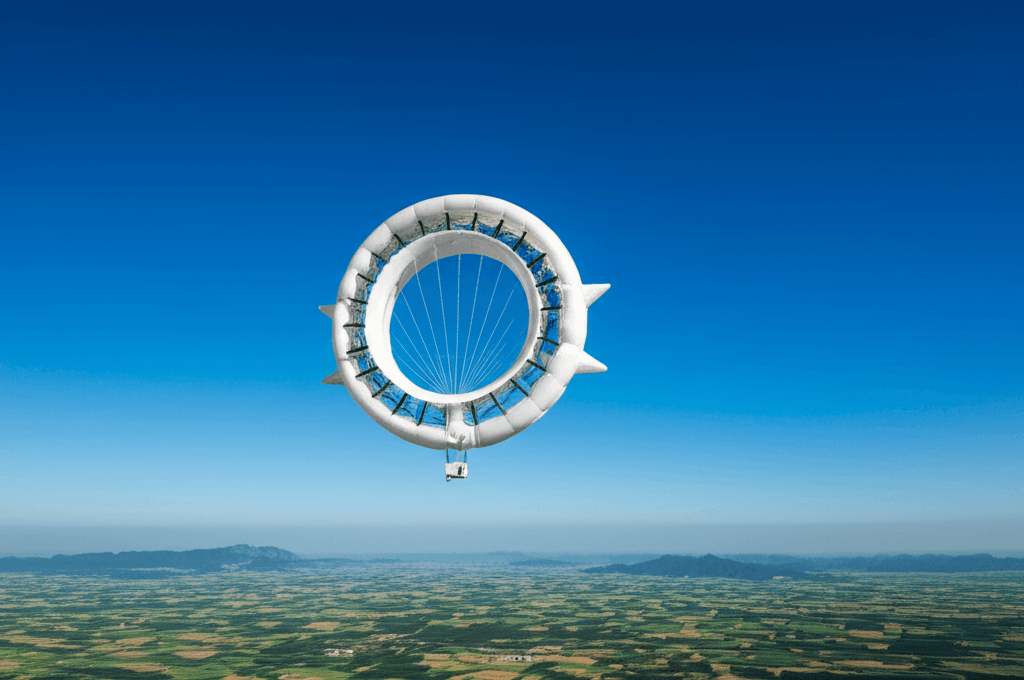
Airborne wind power is seeing a major boost in China, with innovative technologies reaching new heights. Literally. Beijing Lanyi Yunchuan Energy Technology Co. has begun grid-connected testing of its Stratosphere Airborne Wind Energy System (SAWES), a megawatt-scale prototype designed to harness the stronger, more consistent winds at 2000 meters above ground level (AGL) in Yibin, Sichuan Province.
At that altitude, winds avoid the turbulent boundary layer closer to the Earth’s surface, offering a significant advantage over traditional wind turbines. The SAWES S2000 prototype utilizes an aerostat with 12 flying turbines, boasting a peak capacity of three megawatts. Its dimensions are substantial, measuring 60 meters in length and 40 meters in diameter, leaving ample room for future scaling and optimization.
China’s High-Flying Energy Ambitions
The double-hull construction of the S2000 is particularly intriguing. The outer gas bag appears designed to funnel and accelerate air into the turbines. Further wind tunnel testing and computational fluid dynamics (CFD) renderings would be invaluable to fully understand the airflow dynamics within this innovative structure. During its initial test flight in January 2026, the system generated 385 kilowatt-hours of electricity in 30 minutes, demonstrating an average capacity factor of approximately 25%. This promising start paves the way for extensive testing to validate the system’s endurance and power generation capabilities.
The concept of flying wind turbines is not entirely new. Earlier iterations include homemade kite generators and professionally developed kite systems. However, SAWES employs helium for lift, a design choice that offers enhanced control and the ability to support larger structures. The added cost of helium will be a crucial factor in determining the economic viability of this approach. It will be interesting to see how it develops. Check out related Industries news for more on renewable energy.
The Future of Airborne Wind Power
While the S2000’s 2000-meter test flight is only a fraction of the way to the stratosphere, the project represents a significant step forward in airborne wind power technology. The choice of Yibin, an inland location, mitigates the risk of typhoons and ocean storms, providing a stable environment for testing and development. This innovative approach to harnessing wind energy could potentially unlock vast untapped resources, particularly in regions where traditional wind turbines are less effective. The potential for airborne wind power is significant.
Understanding Airborne Wind Power Systems
One of the key advantages of airborne wind power systems is their ability to access stronger and more consistent winds at higher altitudes. Traditional wind turbines are limited by the height of their towers, restricting their access to optimal wind resources. Airborne systems, on the other hand, can operate at altitudes where winds are less turbulent and more predictable. The result is increased energy capture and higher capacity factors.
“Airborne wind power offers a compelling alternative to traditional wind energy, with the potential to reduce costs and increase energy production.”
The development of airborne wind power is an ongoing process, and there are still many challenges to overcome. However, the progress made in recent years has been remarkable, and the technology is showing increasing promise. As the technology matures, it is likely that airborne wind power will play an increasingly important role in the global energy mix.
The Road Ahead
The success of the SAWES project could pave the way for wider adoption of airborne wind power technologies. While challenges remain, including cost optimization and long-term reliability, the potential benefits are substantial. Airborne wind power offers a promising avenue for expanding renewable energy capacity and reducing reliance on fossil fuels. The development of **airborne wind power** represents a significant advancement in renewable energy technology. As testing progresses, the world will be watching to see if **airborne wind power** can provide a scalable and cost-effective alternative to traditional wind energy sources. The team will continue to refine the **airborne wind power** system. The **airborne wind power** prototype marks a pivotal step.
China’s investment in this technology underscores its commitment to clean energy innovation and its ambition to become a leader in the global renewable energy landscape. This venture is much more likely to catch on than harvesting energy from trees.


