
The **ADP employment report** data, released today by payroll processor ADP, was massively revised going back to 2010, now showing erratic and massive month-to-month job gains and losses going back to 2010 that are completely different than the data for the same period released a month ago, rendering reliance on the report for indications of employment trends useless.
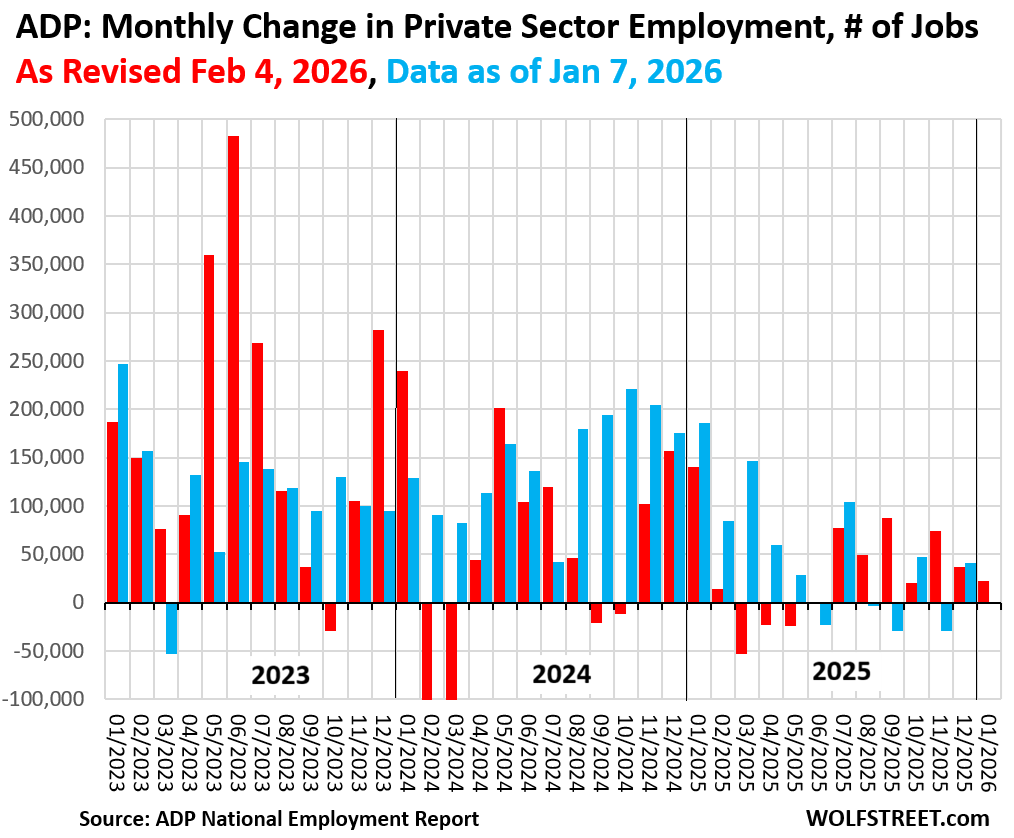
The chart shows ADP’s new revised data of the month-to-month changes in employment (red columns), and the prior data released on January 7, 2026 (blue columns).
There is hardly any correlation between the red columns and the blue columns. And these erratic differences between new data and the prior data go all the way back to 2010, when ADP began this data series.
For example:
In 2025, the new version (red) shows job declines in March, April, and May, when the old version showed substantial job gains (blue).
Then for the second half of 2025, the new version (red) shows much bigger job gains of 345,000 for June through December, than the old version (131,000).
For 2024, the new version shows big job losses in February and March (red), while the old version showed moderate gains (blue).
And then again in September and October 2024, the new version showed job losses (red), when the old version showed massive job gains (blue).
For 2023, the new version shows huge job gains for May, June, and July, while the old version showed much smaller job gains.
These massive differences go back all the way back to 2010.
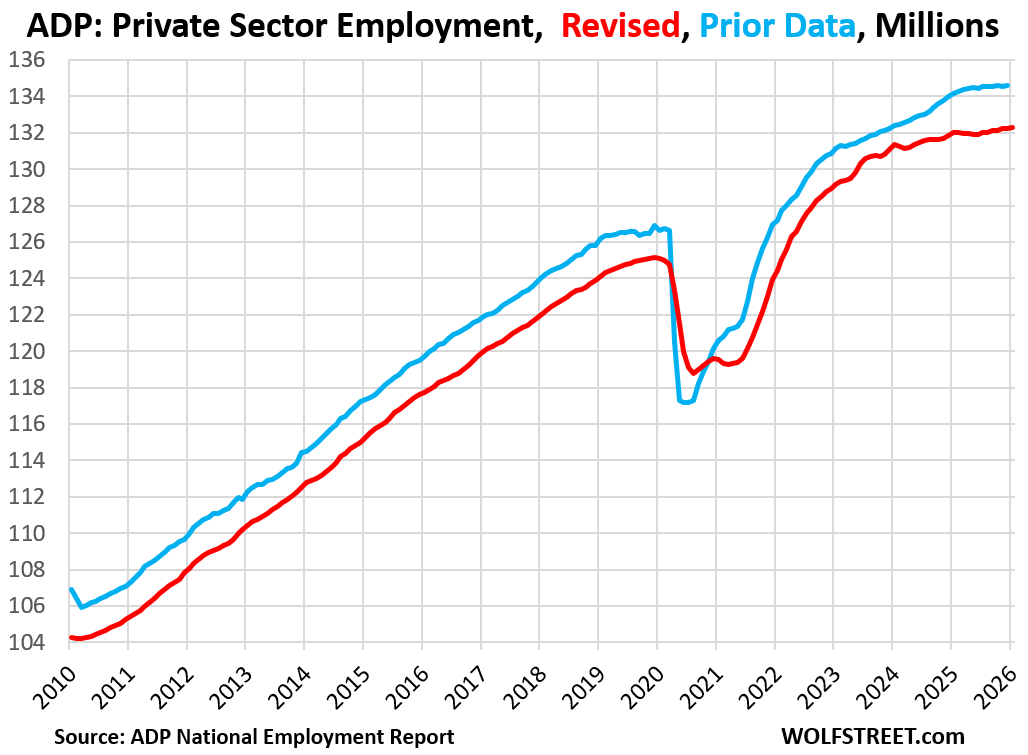
The entire data set was massively revised.
ADP’s entire data series going back to 2010 was heavily revised, and shifted down by about 2.5 million jobs across the entire period. This significantly alters the perceived trajectory of employment trends.
In the press release, ADP said about the revisions:
“The January 2026 report reflects a scheduled annual revision of the ADP National Employment Report. The data series has been reweighted to match the Quarterly Census of Employment and Wages (QCEW) benchmark data through March 2025.
“Beginning this month, in addition to the annual benchmark revision, the **ADP employment report** also will reflect data from the most recent QCEW release.”
The QCEW is produced by the Bureau of Labor Statistics and is based on companies’ quarterly employment tax filings. The BLS adjusts its own nonfarm payrolls data to the QCEW on an annual basis.
ADP gets its data from the payrolls it processes. But many companies use other payroll processors, and many companies process their own payrolls, and ADP has no data on them, including some very large employers. ADP then extrapolates its limited and possibly skewed sample to the national population. It then periodically adjusts this data to the government’s data, the QCEW by the BLS. The reliability of the **ADP employment report** is now questionable.
The QCEW is the gold standard for US payroll data, but lags far behind because it’s based on quarterly tax filings with delayed filing deadlines; and it is not complete either. For more related Finance news, stay tuned to The Financial Standard.
Massive Revisions Impact the ADP Employment Report
The inconsistencies highlighted by the revisions to the **ADP employment report** raise serious concerns about its usefulness as a leading economic indicator. The erratic differences between the initial and revised data, spanning over a decade, suggest that the report may not accurately reflect the true state of the labor market.
These revisions underscore the challenges in accurately capturing real-time employment data. While the QCEW serves as a more reliable benchmark, its lag time limits its utility for immediate analysis. Investors and policymakers must exercise caution when interpreting the **ADP employment report** and consider it in conjunction with other economic indicators.
The dramatic revisions to the **ADP employment report** have rendered it unreliable for assessing employment trends. The significant discrepancies between the original and revised data highlight the challenges of accurately tracking employment in real-time.
Source: Wolf Street