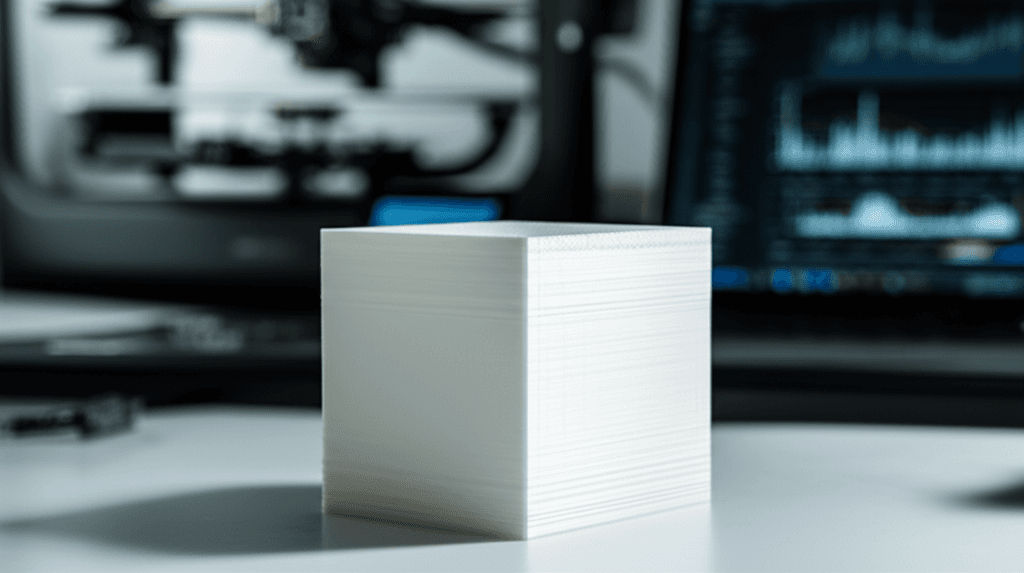
3D print smoothing just got a whole lot faster, thanks to a new technique that could eliminate the need for ironing. A recent discovery by [Make Wonderful Things] suggests that meticulous parameter optimization can produce top-quality surfaces directly from the printer, saving significant time and resources. The traditional method of ‘ironing’ 3D prints, where the print head drags across the top layer to smooth it, might soon become a thing of the past.
The Secret to 3D Print Smoothing
The key to achieving superior 3D print smoothing lies in precisely tuning the printing parameters. According to [Make Wonderful Things], line width, flow ratio, and print speed are the crucial factors. By systematically analyzing and optimizing these variables, it’s possible to achieve a smooth top surface without resorting to ironing.
The initial number of potential settings combinations was staggering, with 19,200 possibilities. To tackle this challenge, the researcher implemented techniques from mathematician [George E. P. Box] and employed Bayesian analysis. These methods significantly reduced the amount of printing required to identify the ideal settings for optimal surface finish.
Statistical Analysis for Perfect Prints
The statistical approach proved remarkably effective. The optimized prints exhibited surface quality comparable to traditionally ironed parts. More impressively, this new method reduced printing time by approximately 34%. This represents a substantial efficiency gain for 3D printing projects.
“Optimizing print parameters offers significant time savings and improved surface quality compared to traditional ironing techniques.”
It’s important to note that the effectiveness of this technique may vary depending on specific printing conditions and materials. There are also variations on traditional ironing that might still be preferable in some situations. However, this research provides a compelling alternative for achieving smooth surfaces efficiently. For more on related Industries news, check out our other articles.
Beyond Traditional Ironing
The implications of this research extend beyond mere time savings. By optimizing print parameters, manufacturers can potentially reduce material waste and improve the overall quality of 3D-printed products. This could lead to increased adoption of 3D printing across various industries, from prototyping to mass production.
The potential for further refinement of this technique is also significant. As 3D printing technology continues to evolve, sophisticated algorithms and machine learning could be used to automatically optimize print parameters for different materials and geometries. This would further streamline the 3D printing process and unlock new possibilities for creating complex and high-quality parts.
Ultimately, the goal is to achieve perfect prints directly from the printer, without the need for post-processing steps like ironing. This research represents a significant step towards that goal, offering a promising path to faster, more efficient, and higher-quality 3D printing.
Source: Hackaday