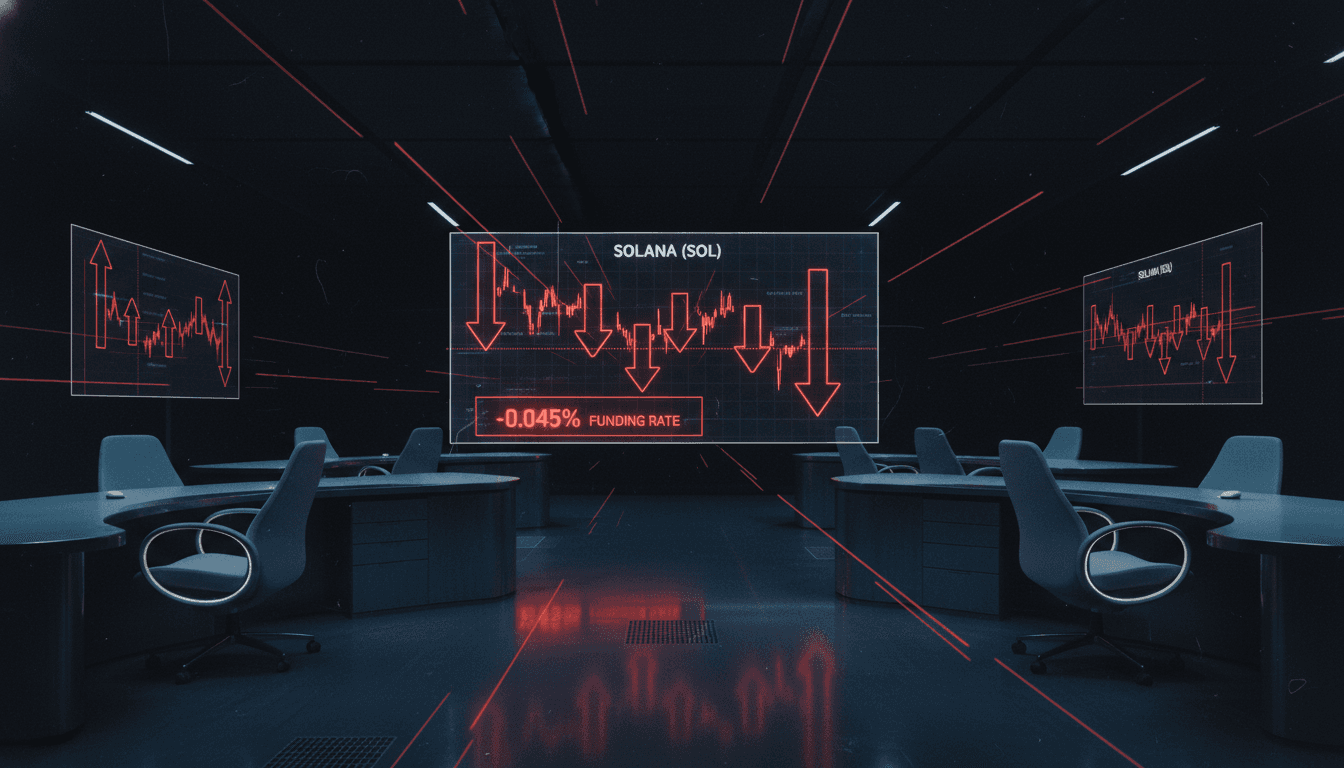
Solana funding rate recently turned negative, signaling a bearish sentiment among traders and raising concerns about a potential drop in SOL’s price to $78. This significant shift occurred around May 19, 2026, following a 15% correction in SOL’s price after it was rejected at $98 on May 11.
Understanding a Negative Funding Rate
In cryptocurrency perpetual futures contracts, a funding rate is a periodic payment exchanged between long (buy) and short (sell) traders. Its primary purpose is to keep the futures price aligned with the underlying spot price of the asset.
- Positive Funding Rate: When the funding rate is positive, long position holders pay short position holders. This typically indicates a bullish market where the futures price is higher than the spot price.
- Negative Funding Rate: A negative funding rate means that short position holders pay long position holders. This occurs when the futures price is lower than the spot price, suggesting a bearish sentiment where more traders are betting on a price decline.
The SOL perpetual futures funding rate dropped to -3% on Tuesday, May 19, 2026, a significant decrease from +8% on the preceding Saturday. Under neutral market conditions, this rate usually hovers around +9%. This sharp decline indicates an increased demand for short SOL positions, reflecting the market’s current bearish outlook on Solana.
Factors Driving Solana’s Bearish Sentiment
Several factors are contributing to the negative funding rate and the bearish outlook for Solana:
- Declining Network Activity: Solana’s decentralized exchange (DEX) activity has decreased by 56% since January 2026, leading to reduced ecosystem revenue and lower demand for SOL. Weekly DEX volumes fell from an average of $25 billion in January to $11 billion, and DApp revenue stabilized near $20 million per week, down from $35 million.
- Increased Competition: Rival blockchain networks, such as Base and Hyperliquid, are posing direct threats to Solana by aggressively capturing DEX market volume. This competition is seen as a major factor, especially as investor interest in memecoins, which previously fueled some Solana activity, appears to be fading.
- Price Correction and Support Levels: SOL experienced a 15% correction after failing to break above $98 on May 11. It retested the $83 level on May 19, and analysts are now closely watching the $78-$83 region as a critical support zone. If SOL fails to hold the $83 support, a retest of $78 is anticipated.
Solana Funding Rate Signals Further Downside Risk
“The sharp drop in Solana’s funding rate, coupled with declining network activity and increased competition, paints a challenging picture for SOL’s immediate future,” noted a market analyst.
Analysts are divided on Solana’s short-term trajectory. While some believe that if SOL holds the $83-$85 support, it could attempt a recovery towards $88, $92.89, and potentially $97.79, others warn that a failure to hold the current support could lead to a drop to $78, and even further to the $60-$72 range if $78 doesn’t hold. Solana’s all-time high was $293.31, reached in January 2025. As of May 19, 2026, SOL was trading around $84.53.
What’s Next for SOL?
The current negative Solana funding rate underscores a significant shift in market sentiment, with traders increasingly betting against the cryptocurrency. Investors should closely monitor the $78-$83 support zone as a crucial indicator of SOL’s near-term price direction. A continued decline in network activity and persistent competition could further depress demand for SOL, potentially leading to additional price corrections. For more insights into the crypto market, explore our related Crypto news.