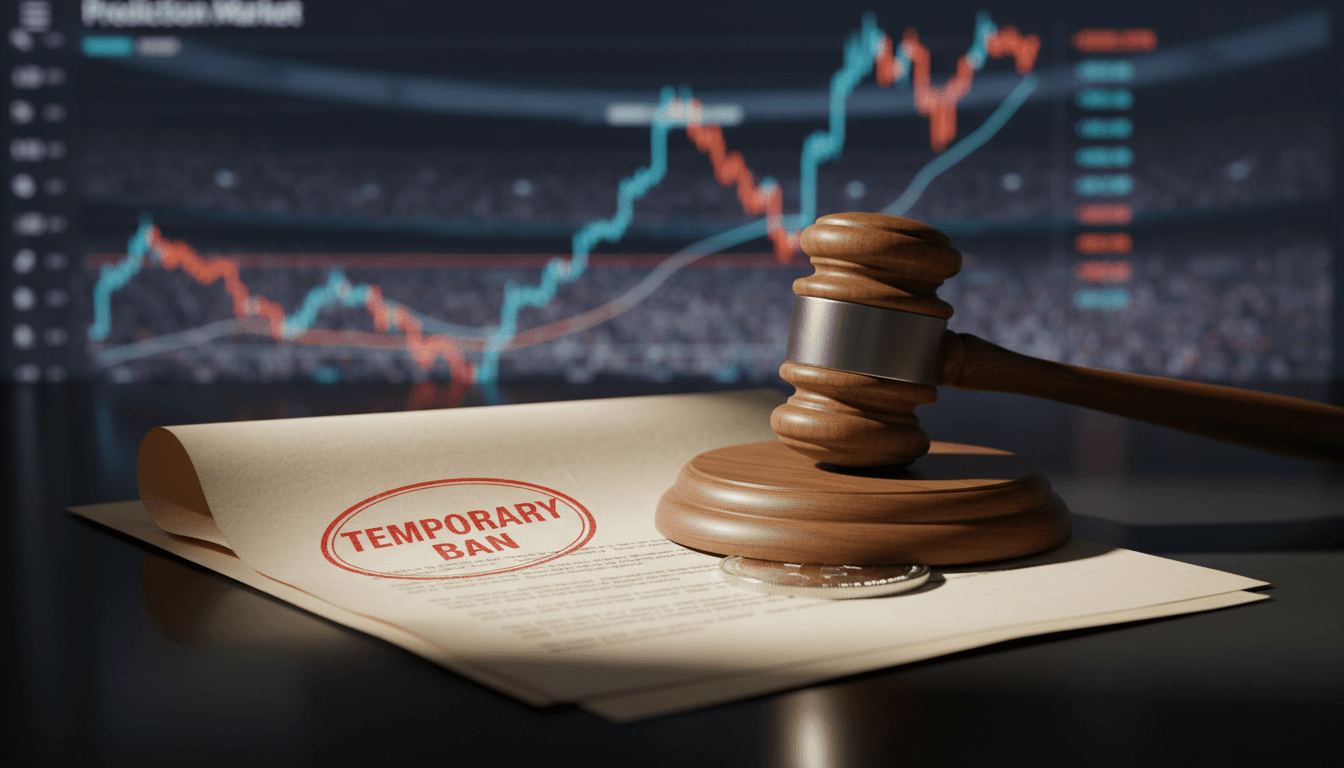
Kalshi Nevada ban has been temporarily imposed for 14 days by a state court, escalating the prediction market firm’s legal dispute with Nevada regulators over whether its offerings constitute illegal sports betting. This critical development follows the Ninth Circuit Court of Appeals’ denial of Kalshi’s emergency request for a stay, which cleared the path for Nevada regulators to pursue a temporary restraining order against the New York-based company.
The core of this intricate legal battle hinges on the classification of Kalshi’s “event contracts.” Nevada regulators, primarily the Nevada Gaming Control Board (NGCB) and the Nevada Attorney General, assert that these contracts, particularly those tied to sports outcomes, are essentially sports wagers. As such, they argue, these offerings fall squarely under the state’s stringent gaming laws, necessitating Kalshi to obtain proper licensing. Conversely, Kalshi maintains that its offerings are sophisticated financial instruments, akin to derivatives, which are regulated by the U.S. Commodity Futures Trading Commission (CFTC). Kalshi contends that federal law should preempt state-level gaming regulations in this context.
The Players and the Precedent
Key entities embroiled in this dispute include Kalshi, the Nevada Gaming Control Board, the Nevada Attorney General, the U.S. Ninth Circuit Court of Appeals, and the U.S. Commodity Futures Trading Commission. The CFTC’s involvement is crucial as Kalshi argues it has exclusive jurisdiction over its event contracts, classifying them as “swaps.” However, a pivotal moment occurred on November 25, 2025, when U.S. District Judge Andrew Gordon dissolved a preliminary injunction that had previously favored Kalshi. Judge Gordon ruled that Kalshi’s expanded sports products, specifically prebuilt parlays and player-prop-style markets, were not swaps under the Commodity Exchange Act and bore a strong resemblance to sportsbook bets, thus falling under Nevada’s gaming regime.
Escalation of the Kalshi Nevada Ban
The timeline of this dispute underscores its rapid escalation. In March 2025, the NGCB issued a cease-and-desist letter to Kalshi. While an initial federal judge sided with Kalshi in April 2025, granting a preliminary injunction, this was overturned in November. Following this, in February 2026, Nevada gaming regulators filed a lawsuit seeking to block Kalshi, and a federal appeals court declined to halt the November order. The most recent blow to Kalshi came on March 20, 2026, when the Ninth Circuit Court of Appeals denied its emergency stay request, directly leading to the current 14-day temporary Kalshi Nevada ban. This ruling allows Nevada regulators to enforce the restraining order, halting a wide range of Kalshi’s contracts within the state.
“Nevada’s motivation stems from its desire to protect its highly regulated gaming industry and ensure that all entities offering wagering activities comply with state laws, including those related to age restrictions and safeguards against insider betting and match-fixing.”
Broader Implications for Crypto and Prediction Markets
The legal battle is primarily unfolding in Nevada courts, particularly the Carson City District Court, with appeals reaching the U.S. Ninth Circuit. Nevada’s staunch position is rooted in its commitment to protecting its established gaming industry, which is subject to rigorous regulations concerning age limits and integrity. Regulators argue that Kalshi’s continued unlicensed operation poses an “existential threat” to the state’s gaming sector, noting a rapid expansion of Kalshi’s sports-related betting coinciding with a decrease in business for regulated Nevada gambling operations. This dispute is not isolated; it reflects a broader national tension between state gaming regulators and prediction market companies, with other states like Massachusetts also seeking injunctions against Kalshi. The ultimate resolution of this conflict, which could potentially reach the U.S. Supreme Court, will have significant implications for how prediction markets and crypto-adjacent financial instruments are classified and regulated across the United States. This ongoing legal challenge highlights the complex intersection of financial innovation, state-level consumer protection, and federal regulatory oversight in the rapidly evolving digital asset landscape. Investors and market participants in related Crypto news should closely monitor the outcome of the Kalshi Nevada ban.