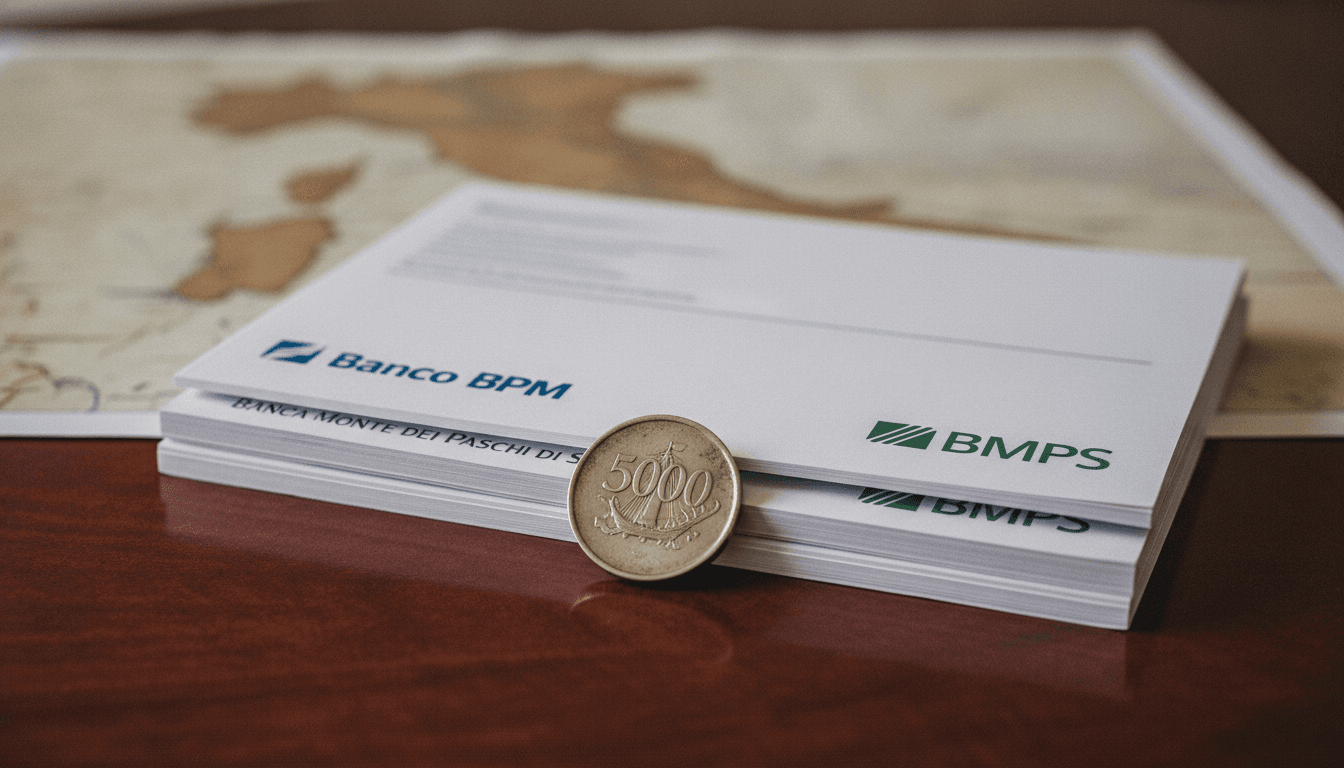
A potential merger to form Italy’s second-biggest bank is now firmly on the table, as Banco BPM announced on Sunday its intention to invite Banca Monte dei Paschi di Siena (MPS) for discussions. This long-anticipated tie-up, if realized, would create a new banking powerhouse valued at approximately €50 billion ($58 billion) on the Milan bourse, significantly reshaping the Italian financial landscape and surpassing UniCredit in market capitalization.
The announcement by Banco BPM, which has been unanimously approved by its board – including representatives from its main shareholder, France’s Crédit Agricole – signals a definitive move towards consolidating Italy’s banking sector. Banco BPM has expressed interest in a “merger of equals,” emphasizing an equitable weighting for both entities within the combined group. While specific structural details remain undisclosed, the strategic intent is clear: to leverage synergies and scale to drive substantial financial gains. Banco BPM estimates that such a merger would boost its earnings per share by more than 10%, underpinned by projected annual pre-tax benefits exceeding €1.1 billion.
The Strategic Imperative: Forming Italy’s Second-Biggest Bank
This initiative could usher in a fresh wave of consolidation in Italian banking, following a period of intense M&A activity last year. The rationale behind forming Italy’s second-biggest bank is compelling, driven by the pursuit of enhanced market share, operational efficiencies, and a stronger competitive stance against larger European rivals. For Banco BPM, the move represents a culmination of strategic positioning, having become a key investor in MPS in November 2024. This investment was part of the Italian government’s reprivatization efforts for the bailed-out Tuscan bank, strategically placing domestic investors as core shareholders and setting the stage for future integration.
The path to this potential merger has not been without its challenges. Prospects of a BPM-MPS tie-up previously spurred UniCredit to launch a takeover bid for Banco BPM. This aggressive move, initiated after Banco BPM’s investment in MPS, ultimately failed in July 2025. However, it effectively stalled Banco BPM’s pursuit of alternative M&A strategies, underscoring the high stakes and competitive pressures within the Italian banking sector. With UniCredit’s attempt to block the deal now in the past, the runway is clear for Banco BPM to advance its vision.
A History of Strategic Moves
Banco BPM’s journey to this point reflects a calculated strategy of growth and consolidation. Formed in 2017 from the merger of Banco Popolare and Banca Popolare di Milano, it quickly established itself as Italy’s third-largest bank by assets. Its subsequent strategic investment in MPS in late 2024 was a crucial step, positioning it to capitalize on the Tuscan bank’s reprivatization and its extensive branch network. This move demonstrated a long-term vision for sector leadership, anticipating the very discussions now underway to form Italy’s second-biggest bank.
Banca Monte dei Paschi di Siena, with its storied history dating back to 1472, has faced significant challenges in recent years, including a state bailout. Its integration into a larger, more stable entity like Banco BPM would offer a pathway to renewed strength and market confidence, leveraging its deep roots in the Italian economy. The synergy between Banco BPM’s robust commercial banking operations and MPS’s historical presence could unlock substantial value.
Market Implications and Future Outlook
The potential creation of Italy’s second-biggest bank holds significant implications for the broader European financial market. Such a large-scale merger would not only recalibrate the competitive dynamics within Italy but also enhance the combined entity’s standing on the international stage. Investors will be closely watching for details on deal structure, integration plans, and potential divestitures. The estimated annual pre-tax benefits of over €1.1 billion and a more than 10% increase in earnings per share suggest a financially attractive proposition, signaling a positive outlook for shareholders.
“This proposed merger represents a strategic masterstroke, poised to redefine the competitive landscape of Italian banking and deliver significant value through scale and synergy,” commented a senior analyst tracking the European financial sector.
As MPS prepares for its board meeting on Monday, where the matter is expected to be discussed, the financial world awaits the next steps in what promises to be a transformative deal. The success of this merger to form Italy’s second-biggest bank could set a precedent for further consolidation across Europe, as banks seek to build resilience and efficiency in an increasingly complex regulatory and economic environment. The focus will now shift to the intricate details of integration, cultural alignment, and the realization of the projected synergies that underpin this ambitious endeavor.