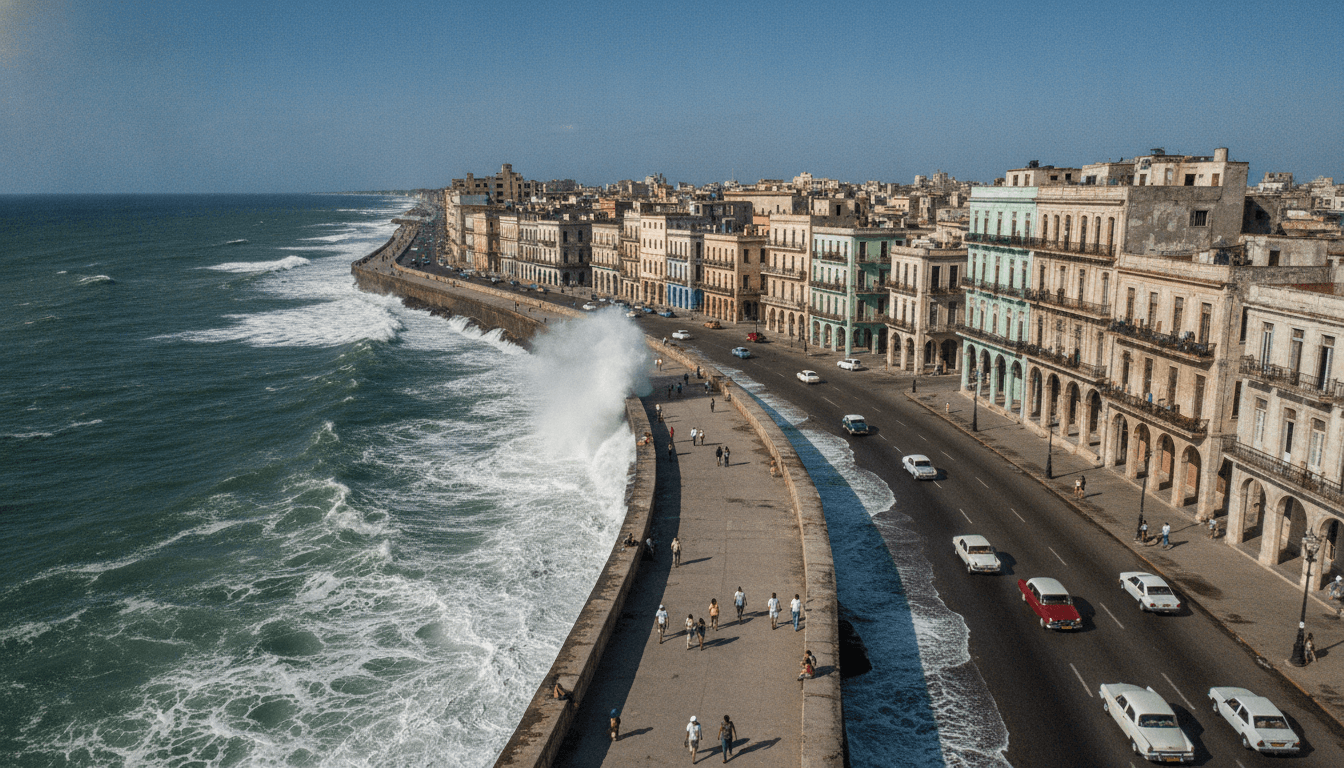
A **Cuba state power collapse** presents a significant and dangerous security vacuum on the United States’ doorstep, a recent analysis from *The National Interest* warns. This stark assessment comes as the economic noose around the world’s longest-sanctioned nation tightens, with foreign businesses fleeing and UN officials highlighting widespread harm to the Cuban population.
The US government has intensified sanctions on Cuba, targeting its president, his family, and the powerful GAESA conglomerate. This has led to a critical fuel shortage, devastating livelihoods, and creating a humanitarian crisis. UN High Commissioner for Human Rights Volker Türk recently condemned these actions, noting the direct harm to vulnerable Cubans, including preventable deaths due to lack of essential medical supplies.
Escalating Pressure and Unintended Consequences
Despite the immense pressure, the Cuban government has not crumbled as some in Washington might have hoped. The indictment of former President Raúl Castro on murder charges, for instance, did not lead to the swift abduction many anticipated. Instead, as surveillance aircraft circle the island and high-level US intelligence officials meet with Cuban counterparts, the situation remains volatile.
Dr. Hal Philip Klepak, writing in *The National Interest*, a publication broadly associated with the realist school of international studies, strongly cautions against the current US approach. He challenges the characterization of Cuba as a “failed state posing a threat to the United States,” a justification used for tightened sanctions and military threats. Pentagon assessments for decades have consistently found Cuba not to be a direct national security threat, except in scenarios of widespread disorder leading to a mass exodus.
“In a region plagued by criminal networks and narcotics trafficking, Cuba has long been a remarkable outlier.”
Indeed, Cuba has demonstrated significant success in combating narcotics trafficking and maintaining law enforcement, boasting a remarkably low Global Organized Crime Index ranking compared to its regional neighbors. This stability, often overlooked, is critical for US national security interests.
The Looming Threat of a Cuba State Power Collapse
While Cuba currently maintains order, the ultimate goal of Washington’s economic privations – including a five-month fuel blockade causing hunger and medical shortages – is to instigate a popular uprising. However, as Dr. Klepak warns, this strategy risks creating far greater instability. A **Cuba state power collapse** could transform a stable, albeit adversarial, neighbor into a chaotic “black hole for law enforcement” just 90 miles from US shores.
The notion that mass discontent would simply lead to a stable, ready alternative government is highly questionable given the lack of a unified political opposition. Instead, the most likely outcomes are either a security vacuum or a long-term US military occupation, a nation-building project with little chance of success, mirroring past debacles in Iraq and Afghanistan. Such an intervention could even trigger widespread hemispheric turmoil, far from demonstrating dominance.
Cuba’s history demonstrates its ingrained capacity for resistance. As Chatham House senior fellow Chris Sabatini notes, “The Cuban regime, for all of its sins, has basically survived under a defensive crouch…. it is built to resist.” Even an economically weakened Cuba may prove incredibly difficult to dominate militarily. The lessons from past interventions, including Vietnam and Afghanistan, suggest that even low-intensity insurgencies can inflict heavy casualties, financial costs, and political exhaustion on an occupying force.
The current US policy gambles with regional stability, risking a profound security challenge on its own doorstep. Rather than achieving its desired outcome, pushing for a **Cuba state power collapse** could inadvertently create a far more dangerous and unpredictable future for the entire region. For more insights on global financial implications, explore our related Finance news.