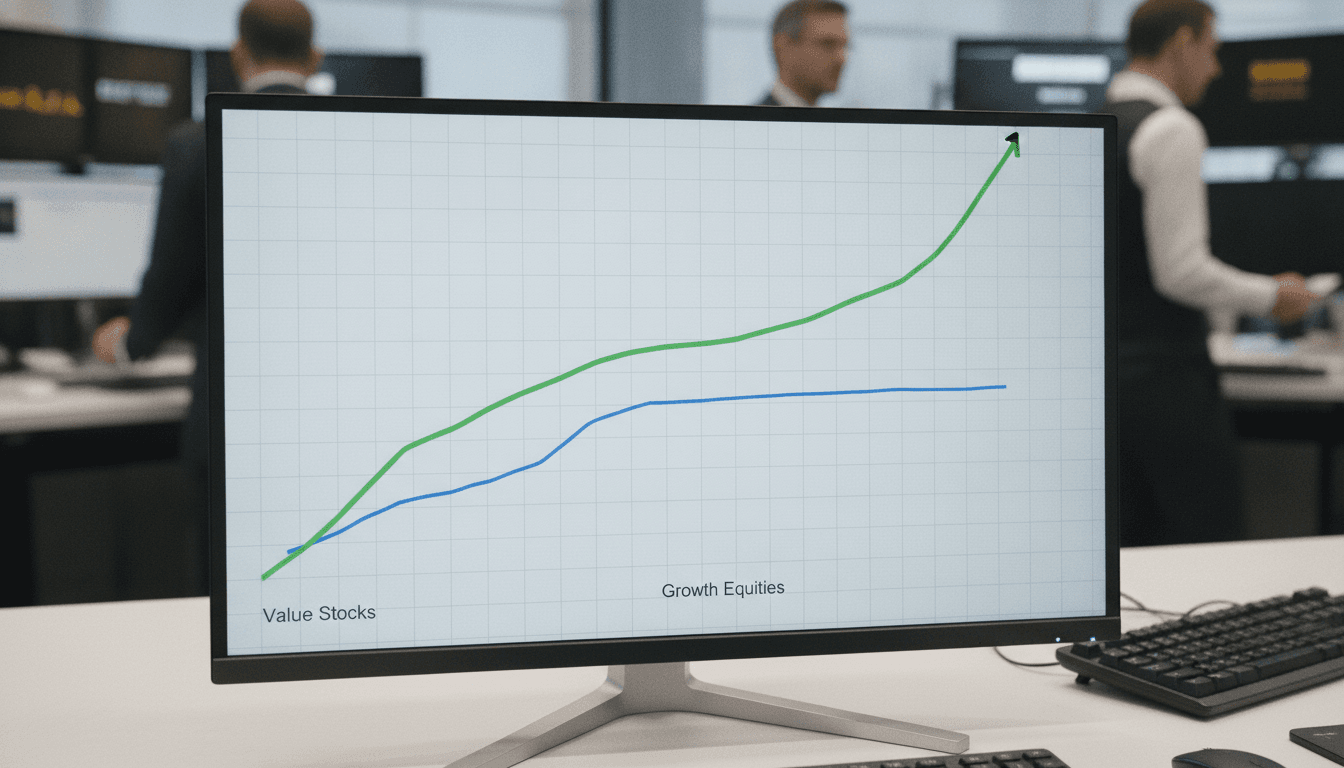
Value stocks are significantly outperforming growth equities in the first half of 2026, marking the widest margin since 2022, as investors broaden their optimism beyond technology’s earnings growth. This shift reflects increased confidence in the strength of the U.S. economy, a sentiment bolstered by robust May jobs data released last week.
The Russell 1000 Value Index (RLV) has surged 14.8% year-to-date through Friday, substantially outpacing the Russell 1000 Growth Index’s (RLG) modest 2.7% gain over the same period, according to FactSet data. This impressive performance indicates a strong rotation into fundamentally sound, undervalued companies.
Broadening Economic Strength Fuels Value Surge
The investor motivation behind value’s biggest outperformance in years appears to be an increased comfort in the strength of the U.S. economy, a view that garnered support from strong May jobs data out last week. This indicates that economic growth is becoming more widespread, moving beyond the concentrated gains seen in the tech sector.
“We’re actually pretty optimistic about the returns for value stocks,” said Dave Grecsek, director of investment strategy at wealth-management firm Aspiriant. “We’re starting to open up a window here where these value-style businesses can get back to generating better earnings growth. Tech is still strong in terms of earnings growth, but now we’re seeing much broader participation.”
Even as the S&P 500 index rose 0.5% and SpaceX’s stock (SPCX) surged 19% in its debut, investors continued to rotate into areas of the stock market sensitive to economic growth. This benefits value-oriented sectors, suggesting that the artificial-intelligence trade, while still appealing, is no longer the sole driver of market momentum. Chris Galipeau, senior market strategist at Franklin Templeton, emphasized, “This is not a flash in the pan,” highlighting that earnings power is broadening out.
Key Sectors Driving Value Stock Performance
A closer look at the iShares Russell 1000 Value ETF (IWD) reveals financials as its largest sector as of June 11, with significantly less exposure to technology compared to the iShares Russell 1000 Growth ETF (IWF), where tech comprised around 52% of holdings. Financial companies, often seen as an early indicator of economic health, featured prominently among the value ETF’s top holdings.
These holdings include a mix of robust companies such as Micron Technology (MU), Berkshire Hathaway (BRKB), JPMorgan Chase & Co. (JPM), Alphabet’s Class A and C shares (GOOGL, GOOG), Amazon.com (AMZN), Exxon Mobil (XOM), Johnson & Johnson (JNJ), Intel (INTC), and Cisco Systems (CSCO). This diversified exposure underscores the broad appeal and underlying strength of companies trading below their intrinsic value. Wells Fargo Investment Institute, for instance, is overweight financials, as well as tech, industrial, and utilities, with Scott Wren, senior global market strategist, noting that industrials and utilities should also benefit from the AI boom.
Small-Cap Stocks Join the Rally
The positive sentiment extends beyond large-cap value plays. The Russell 2000 Index (RUT), a key gauge of U.S. small-cap stocks, finished Friday at a fresh record high. This indicates that trades into underowned areas of the equities market, such as small-cap stocks, have significant room to run. “We’re overweight value stocks, and we’re pretty excited about U.S. small-cap stocks right now,” added Grecsek of Aspiriant, reinforcing the broad-based confidence in this market segment. This sustained performance of value stocks suggests a durable shift in market dynamics.
The current landscape signals a robust and diversified market, where economic strength is translating into wider earnings participation. Investors are clearly favoring companies with solid fundamentals and attractive valuations, pointing to a more sustainable growth trajectory across various sectors. This sustained outperformance of value stocks marks a significant shift from recent years dominated by growth-oriented tech giants, indicating a new phase of market leadership.